Learn how to choose the right flexible packaging structure based on product type, barrier needs, resistance, sealing performance, shelf life, distribution, and sustainability goals.
Monomaterial Packaging: When It Makes Sense and What Advantages It Offers
The flexible packaging industry is evolving toward more sustainable, efficient, and circular-economy-compatible solutions. In this context, monomaterial packaging has become one of the most relevant alternatives for reducing the complexity of traditional structures and improving their recyclability potential.
However, talking about monomaterials does not simply mean “using only one plastic.” It means designing a technically functional structure capable of protecting the product, withstanding converting and filling processes, maintaining strong shelf appeal, and, at the same time, supporting better compatibility with existing recycling streams.
What Is Monomaterial Packaging?
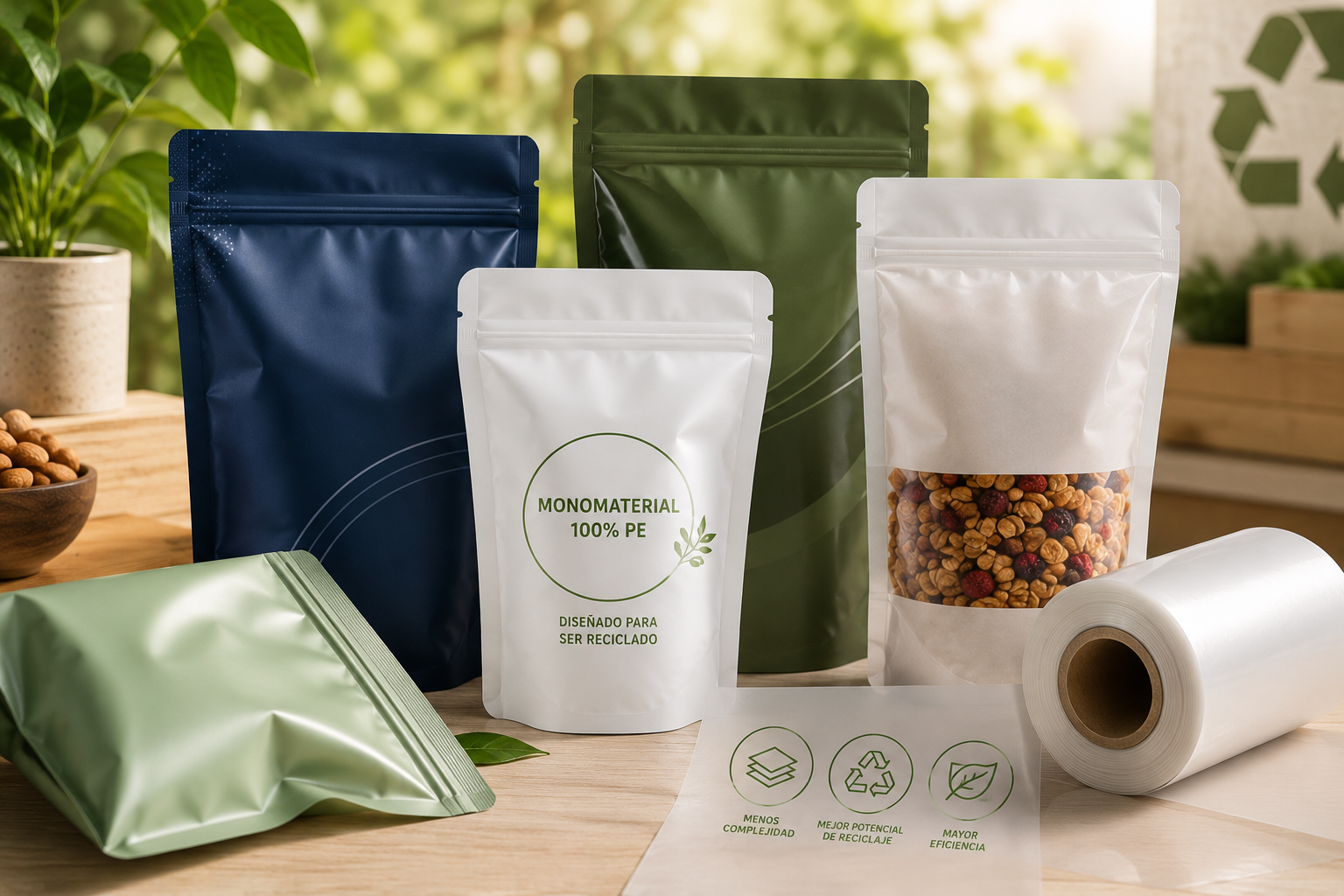
Monomaterial packaging is a flexible structure developed primarily from a single polymer family, such as PE or PP. Unlike conventional laminates that combine very different materials — such as PET, aluminum, nylon, or PE — monomaterial structures aim to maintain compatibility between layers in order to facilitate recycling.
This does not mean the package is made from a single layer. It can still be a multilayer structure, but one designed with compatible materials. For example, a polyethylene-based structure may include different PE layers with specific functions: sealing, stiffness, mechanical resistance, barrier performance, or appearance.
The goal is to achieve the right balance between technical performance and recyclability.
Why Are Monomaterial Structures Important?
For many years, flexible packaging relied on complex multilayer structures to maximize protection, strength, and shelf life. These structures have been highly efficient from a functional standpoint, but they can present challenges during recycling because they combine materials with different chemical and thermal properties.
Monomaterial packaging responds to a growing industry need: developing solutions that can deliver protection and functionality with a simpler composition that is more compatible with recovery and recycling systems.
For brands in food, pet food, personal care, household products, and industrial applications, this type of packaging represents an opportunity to advance sustainability goals without sacrificing the performance requirements of the product.
Main Advantages of Monomaterial Packaging
1. Improved Recyclability Potential
The main advantage of a monomaterial structure is that it reduces incompatibility between materials. By being based on a single polymer family, it may facilitate sorting, processing, and reintegration into recycling chains, provided that the right infrastructure is available and that the full packaging design is compatible.
Recyclability does not depend only on the base material. Inks, adhesives, coatings, valves, zippers, spouts, and other components also play a role. That is why the package must be evaluated as a complete system.
2. Reduced Structural Complexity
Traditional flexible packaging may combine several layers with specific functions: printing, barrier, resistance, sealing, and appearance. In a monomaterial structure, the challenge is to simplify that composition without losing functionality.
This supports cleaner packaging design from a structural standpoint, with less complexity and stronger alignment with circular economy strategies.
3. Compatibility with High-Performance Technologies
The development of materials such as MDO-PE has expanded the possibilities of monomaterial packaging. Molecular orientation in polyethylene can improve stiffness, dimensional stability, resistance, and appearance, allowing it to replace traditional layers such as PET in certain applications.
Additionally, barrier technologies such as EVOH, AlOx, or SiOx may be integrated into specific structures to improve protection against oxygen, moisture, or aroma loss, as long as their compatibility with recyclability and performance objectives is properly validated.
4. Lower Material Usage
In many cases, monomaterial structures allow packaging to be redesigned to optimize gauges, reduce weight, and improve logistics efficiency. This material reduction can help decrease resource consumption, transportation costs, and waste generation.
The objective is not simply to make the package lighter, but to design it so that it maintains resistance, sealability, and protection throughout the supply chain.
5. Response to New Market Expectations
More brands, retailers, and consumers are looking for packaging with a better environmental profile. Monomaterials allow companies to respond to these expectations in a technical way, not just as a communication claim.
For a brand, moving toward a monomaterial package can support sustainability objectives, improve shelf perception, and help prepare for future regulations or global customer requirements.
When Does Monomaterial Packaging Make Sense?
Monomaterial packaging is especially useful when the product does not require extreme barrier conditions or demanding thermal processing, or when the structure can be redesigned to achieve the required performance using compatible materials.
It may be suitable for:
- snacks;
- dry foods;
- coffee, depending on the required barrier level;
- dry pet food;
- refill products;
- personal care products;
- household products;
- certain powders and industrial ingredients;
- secondary or distribution packaging.
Its viability depends on variables such as expected shelf life, oxygen sensitivity, moisture sensitivity, required mechanical resistance, sealing system, packaging format, and distribution conditions.
When May It Not Be the Best Option?
Although monomaterials offer important advantages, they are not a universal solution. Some products require very high barrier performance, extreme thermal resistance, or specific processes such as retort, sterilization, or prolonged exposure to aggressive conditions.
In these cases, conventional multilayer structures or hybrid solutions may still be necessary to prioritize product protection.
A more sustainable package should not compromise product safety, stability, or shelf life. If the packaging fails, the environmental impact may be greater due to product waste, returns, or spoilage.
That is why the decision should be based on technical analysis, not only on an environmental communication objective.
Monomaterial Does Not Automatically Mean Recyclable
One key point must be clarified: just because a package is monomaterial does not automatically mean it is recyclable in every market.
Recyclability depends on several factors:
- availability of local recycling infrastructure;
- compatibility of inks and adhesives;
- presence of components such as zippers, valves, or spouts;
- material color;
- level of post-consumer contamination;
- acceptance of the material within existing recycling systems.
Therefore, the design must consider not only the packaging structure itself, but also how it behaves within the recovery and recycling chain.
The Role of Blue Pack Solutions
At Blue Pack Solutions, we develop monomaterial flexible packaging and recyclable structures designed according to the real needs of each product.
Our approach combines technical performance, material efficiency, and sustainability objectives to create solutions that protect the product, optimize processes, and help brands move toward smarter packaging.
The future of flexible packaging is not about choosing between protection and sustainability. It is about designing structures capable of balancing both.
Protecting what the world creates.
Smarter Packaging. Sustainable Solutions.
Entradas Relacionadas