Discover the top 2026 trends in flexible packaging: recyclable mono-materials, ultrasonic sealing, compostable films, packaging 4.0, and more.
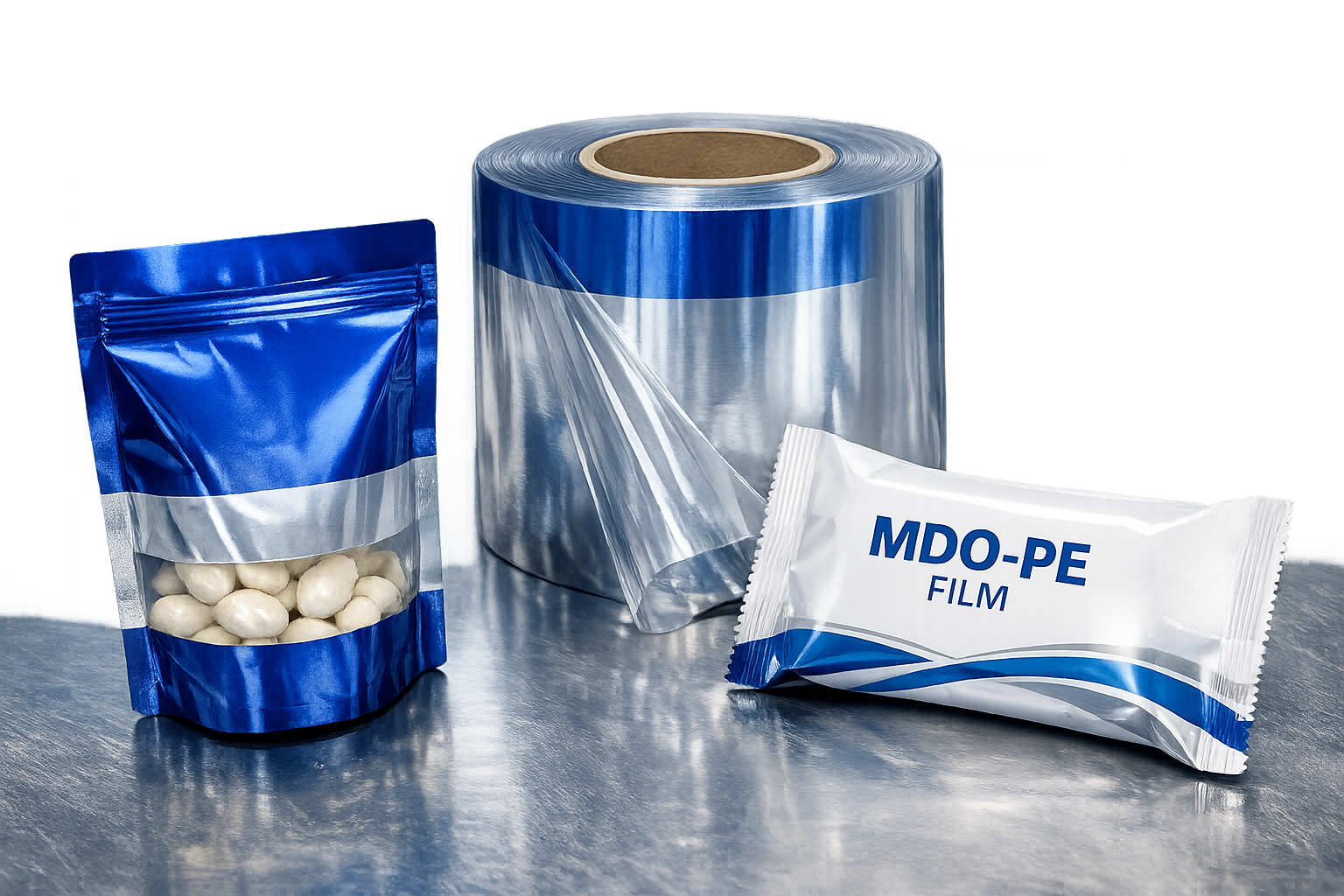
MDO in Flexible Packaging: What It Is, Why It Matters, and How to Engineer It in 2026
Machine Direction Orientation (MDO) has become one of the most relevant enabling technologies for high-performance mono-material flexible packaging. For packaging engineers, material developers, and converters, MDO is not “just another film”—it’s a way to re-balance stiffness, optics, machinability, and recyclability, especially within PE and PP families.
Below is a technical, practitioner-focused overview of what MDO delivers, where it makes sense, and the critical parameters that determine success on press and on packaging lines.
1) What is MDO—and what does it do to the polymer?
In simple terms, MDO is a process where a cast or blown film is stretched in the machine direction (MD) only through a controlled sequence of heated rolls. That stretching:
- Aligns polymer chains (molecular orientation)
- Increases modulus/stiffness in MD
- Improves optics (depending on resin system and formulation)
- Enables down-gauging while maintaining functional performance
- Changes thermal behavior and shrink response
From a packaging standpoint, the real value is that MDO can make a PE-based film feel closer to a “crisp” BOPP-like web—while staying within the PE recycling stream (MDO-PE), or within PP where relevant (MDO-PP).
2) Core technical benefits (what you typically gain)
Stiffness and “stand-up” behavior
MDO-PE increases web stiffness and can improve pack presentation and handling—especially useful for pouches and premium flowpacks.
Down-gauging with control
You can reduce thickness while keeping performance targets—provided tear, seal, and COF are re-engineered (it’s not a simple thickness swap).
Premium optics and feel
With the right formulation, MDO-PE can deliver strong clarity and a “clean” look, with a more premium tactile response versus standard PE.
A platform for mono-material recyclable structures
Common structures include:
- MDO-PE / tie / PE
- MDO-PE / EVOH / PE (high barrier within a PE-dominant design, depending on the target recycling guidance and application needs)
3) Where MDO is used (best-fit applications)
- HFFS flowpacks (snacks, bakery, confectionery, bars)
- Pouches (stand-up pouches, refill packs)
- Sachets and stick packs (with engineered tear behavior)
- Overwraps and premium secondary wraps
- High-barrier laminations (with EVOH or coatings, depending on barrier targets)
In general, MDO excels when you want stiffness + machinability + shelf appeal, while staying aligned with mono-material strategies.
4) What to watch out for (real conversion + packaging line challenges)
a) Tear behavior (MD vs TD anisotropy)
Orientation increases anisotropy: tear propagation can differ significantly in MD versus TD. This affects:
- notch opening performance
- easy-open behavior
- puncture robustness in distribution
Mitigation: coex design, tear-control layers, orientation tuning, and notch/score design.
b) Sealability and seal window engineering
MDO layers are typically not the sealant. You engineer a sealant layer (often modified PE) for:
- low seal-initiation temperature
- adequate hot tack
- contamination tolerance (powders, oils)
Key point: specify sealing by performance data (hot tack, seal strength, COF), not just “it seals.”
c) COF and web handling
Orientation can change surface friction. If COF drifts:
- feeding/registration issues on VFFS/HFFS
- inconsistent tracking
- stoppages from poor pull
Mitigation: slip/antiblock packages, coatings, and controlled corona strategy.
d) Printing and lamination robustness
MDO can print very well, but requires:
- stable corona level and retention
- control of residual shrink
- adhesive system compatibility (solvent / solventless per application)
5) MDO-PE vs BOPP (practical positioning)
- BOPP: excellent stiffness and optics, widely used for dry products; recycling depends on local PP streams.
- MDO-PE: strategic when you want PE-family recyclability but need improved stiffness and premium appearance versus standard PE webs.
It’s not always a direct replacement—MDO-PE is most valuable when your packaging roadmap is “PE-only” while maintaining performance and shelf presence.
6) How to specify MDO for a real project (engineering checklist)
If you’re building a supplier spec or qualification plan, these items prevent most downstream surprises:
- Target structure (all-PE, PE/EVOH/PE, etc.)
- Total gauge and tolerance
- COF targets (inside/outside) + aging stability
- Corona level and retention requirements
- Sealing performance: SIT, seal window, hot tack
- Mechanical targets: modulus MD/TD, dart impact, puncture, tear
- Optics: haze, gloss, clarity
- Web quality: thickness profile, flatness, telescoping control
- Machine compatibility: HFFS/VFFS, speed, jaw type, ultrasonic vs heat
- Barrier needs (OTR/WVTR), if applicable
Conclusion: MDO as a design platform—not a single film choice
MDO is best understood as a technology platform that enables mono-material structures to approach the functional feel of traditional laminations—while improving machinability and aligning with circularity goals. The winning designs are engineered end-to-end: seal behavior, COF, tear control, lamination chemistry, and equipment interaction.
At Blue Pack Solutions, we develop MDO-based structures tailored to your product, process, and performance targets—so you can validate in plant with real, measurable outcomes.
Want to evaluate MDO for your pouch or flowpack?
We can help define the structure, performance targets, and the trial plan to qualify MDO on your line.
Entradas Relacionadas